The name
Structures optimized by nature
Stereom(STERR-ee-um) is a real structure: the porous calcite lattice an echinoderm skeleton is built from, in sea urchins, starfish and sand dollars.
It is graded. Its architecture changes from region to region, in step with the loads each region carries.
The name fits: this is the geometry Stereom exists to analyze. Continuous, porous, locally varied, and miserable to mesh.
On the pronunciation: both are in use and neither is wrong. Spelled stereom, most speakers say it like the prefix in stereo: STERR-ee-um, the more common form in American English.
Spelled stereome, the long-e STEER-ee-ohm is more usual, and it is heard in British and older academic usage. Say it however you like; the structure doesn’t mind.
The structure
One crystal, mostly empty space
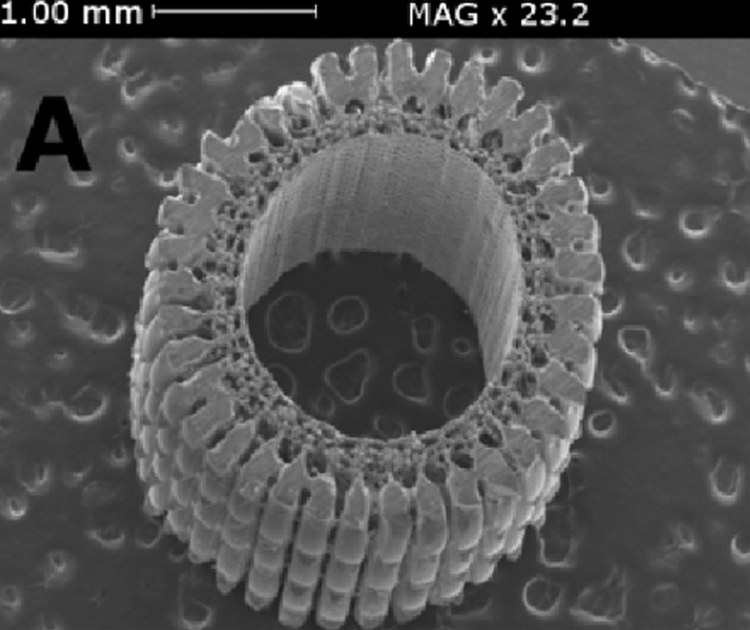
A Heterocentrotus spine can be ten centimeters long and sixty to eighty percent pore space. The whole of it still diffracts as a single crystal of magnesium calcite.
Geological calcite that size splits cleanly along its cleavage planes if you tap it. The spine does not. It fractures conchoidally, in curved shell-like surfaces, the way glass breaks.
The mineral and the pore space each form one continuous, interconnected network. The pores are not voids: they hold living tissue threaded through the mineral.
That soft tissue, not crystallography, sets the shape of the lattice. The geometry is a biological decision, executed in a crystal.
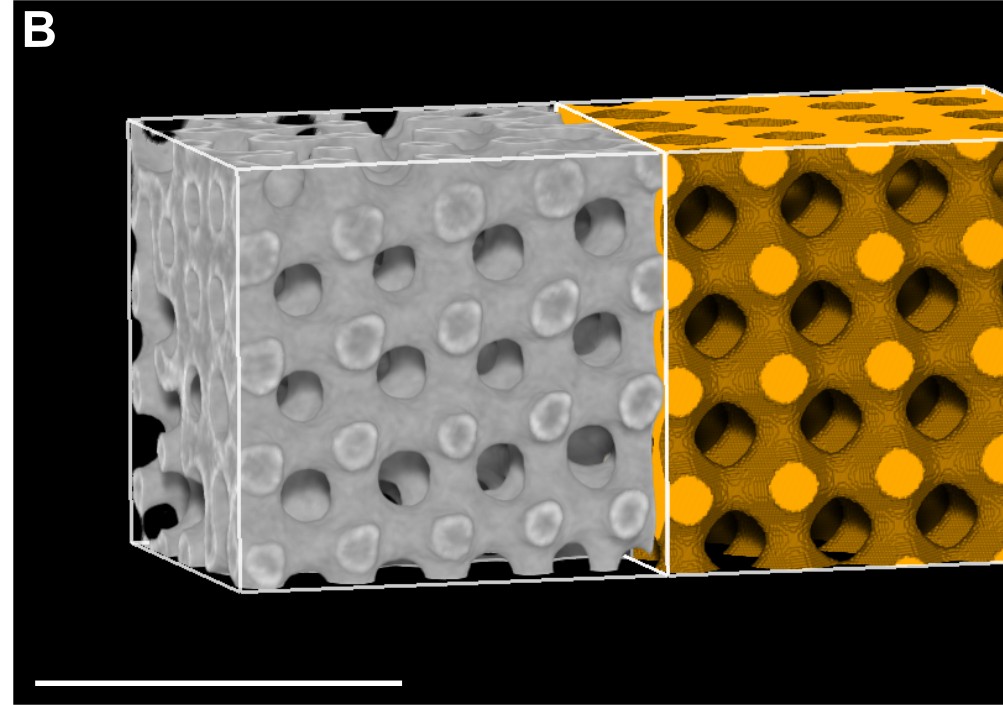
In 2022 the knobby starfish Protoreaster nodosus was found to grow a skeletal lattice that is a diamond triply periodic minimal surface, a geometry engineers design deliberately. Repeat spacing about thirty micrometers, grown as a single crystal.
That finding is about starfish. A sea urchin spine is explicitly not a minimal surface: its curvature is near-constant rather than zero. Test plates carry ordered domains that come closer. The same research group reported both.
The grading
Graded to the load
Across a single skeletal plate, the density of the lattice, the type of its mesh and the orientation of its struts all vary. Those variations track the loads each region carries.
Where a plate carries a spine, the structure at the tubercle it articulates on is dense and closed. Where ligaments pull along one axis, it becomes directional, with aligned galleries running the way the fibres run.
Where the stress state has no preferred direction, it opens into an isotropic mesh.
The grading has a measurable consequence. Stereom shows much lower stress concentration than engineering foams: its surfaces are smooth and near-constant in curvature.
When it does fail, it fails gracefully. Broken struts jam in the narrow pore throats and form dense damage bands instead of running one catastrophic crack.
- 0.2–0.4
- Relative density
- Sixty to eighty percent of the volume is pore space, in a sea urchin spine.
- 17.7 ± 4.0 kJ/kg
- Energy absorbed in compression
- Outperforms many metal- and composite-based foams.
- 3.3
- Struts meeting at a junction
- Engineered foams sit nearer 4.
Measured on Heterocentrotus mamillatus spine stereom by Yang et al., Nature Communications 13:6083 (2022). Porosity varies widely by species, element and measurement method, so these numbers travel with the animal they came from.
The biology
Graded, not remodelling
There is a tempting version of this story: the animal senses load and rebuilds its skeleton in response, the way bone is said to. The evidence is against it.
The one study that tested load-driven remodelling in echinoderms found that not all ossicles showed it. It concluded the mechanism may be exclusive to vertebrate skeletons.
Echinoderms can resorb calcite, but as part of growth and repair rather than as an answer to load.
What holds is the narrower claim. The architecture is graded, and the grading does correspond to the load field.
That correspondence is exactly what a structural solver computes.
In engineering
Easy to build, hard to simulate
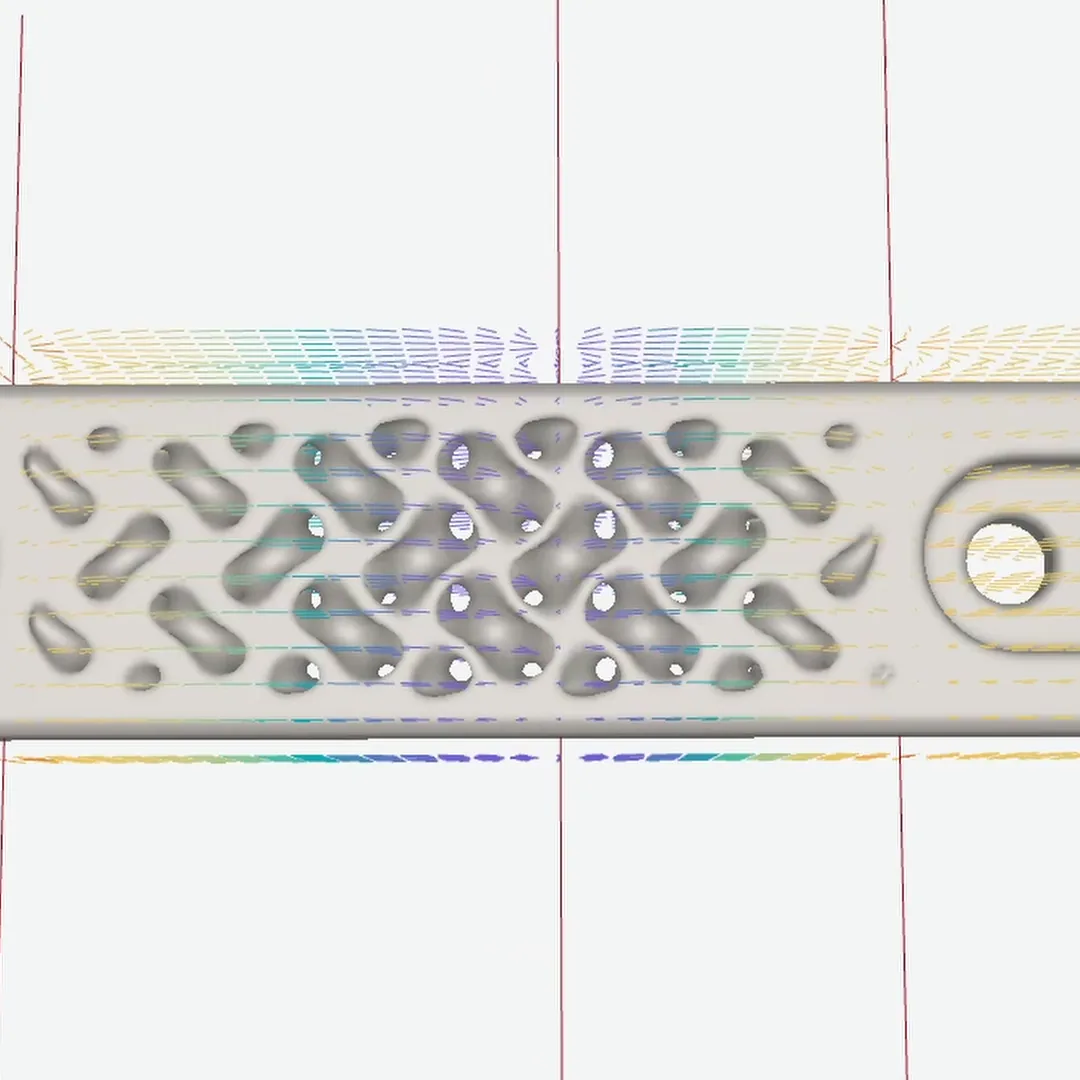
Graded porous structure stopped being exotic. Additive manufacturing made lattices and TPMS surfaces buildable, and putting material where the load is has become an ordinary design goal.
The idea is old. Michell published the limits of material economy in frame structures in 1904.
Topology optimization of the human femur reproduces its trabecular architecture closely enough that its authors called the bone optimal. Nature and the optimizer tend to agree.
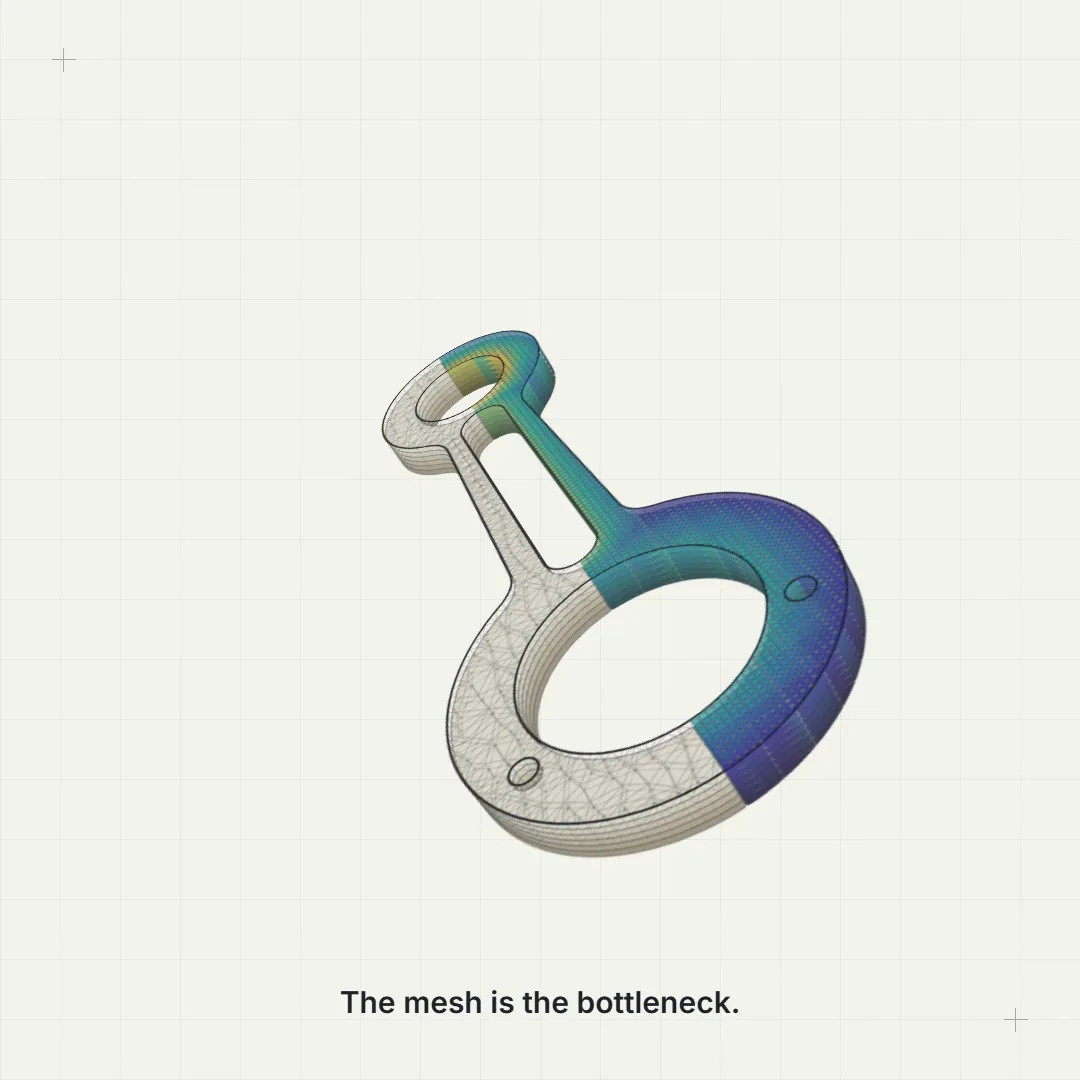
The problem is the analysis. Conventional FEA has to convert geometry into a mesh of tetrahedra that follow every surface, and lattice geometry is punishing for it.
Elements have to be finer than the strut width, which limits how many unit cells can practically be simulated. One graded TPMS specimen has been reported to take about 2.7 million elements.
Getting a TPMS solid into a form a mesher will even accept is its own documented difficulty.
A 2025 survey co-authored by Sandia’s principal meshing researcher still describes the path from model to simulation-ready mesh as feeling “more like careful craftsmanship than a reliable pipeline.”
The same survey notes that small changes in geometry can trigger large changes in meshing behavior. In a parametric definition, that is the part you feel first.
The lattice is old. The same diamond geometry found in a living starfish in 2022 turns up in a crinoid fossil dated to 385 million years.
So the geometry nature has been grading since the Devonian is precisely the geometry our tools handle worst.
What we built
Solve the field, skip the mesh
Stereom takes the implicit field as its input and solves on it directly, immersing the part in a background grid instead of fitting a mesh to its surface.
This geometry is not a surface to begin with. It is a function that answers whether a point is inside the part, and the mesh was always a lossy conversion it never asked for.
The approach is not ours. It is the finite cell method, published by Parvizian, Düster and Rank in 2007, and Schillinger's later survey of it puts the motive plainly: to avoid “expensive and potentially error-prone meshing procedures.”
Ours is the implementation: it runs inside Grasshopper on your own GPU, NVIDIA and CUDA, falling back to the CPU for the same answers, slower.
It carries a verification ladder measuring its accuracy.
Immersed methods trade accuracy for robustness. Febrianto and colleagues, whose work this solver is built on, put it flatly: intrinsically more robust, usually less accurate.
So the accuracy is measured, not assumed: the numbers are published raw as well as extrapolated, checked against an independent solver.
Stereom does not generate lattices. Plenty of tools do that well, and it solves whatever they produce.
It does not optimize your part or grow structure from the load path. That is on the roadmap, with no code behind it today.
Where this comes from
The papers behind this page.
- Yang, Jia, Wu, Chen, Deng, Chen, Zhu & Li, “High strength and damage-tolerance in echinoderm stereom as a natural bicontinuous ceramic cellular solid,” Nature Communications 13:6083 (2022). The mechanics, and the sea urchin curvature finding.
- Yang, Chen, Jia, Deng, Chen, Peterman, Weaver & Li, “A damage-tolerant, dual-scale, single-crystalline microlattice in the knobby starfish,” Science 375:647 (2022). The starfish diamond minimal surface.
- Perricone et al., “The microarchitectural variability in the echinoid skeleton,” Royal Society Open Science 12:241439 (2025). How the architecture varies by region within one plate.
- Raman, Labisch & Dirks, “The ultrastructure of the starfish skeleton is correlated with mechanical stress,” Acta Biomaterialia 193:279 (2025). The correlation with load, and the limits of the remodelling story.
- Su, Kamat & Heuer, “The structure of sea urchin spines, large biogenic single crystals of calcite,” Journal of Materials Science 35:5545 (2000). The single-crystal paradox.
- Seidel et al., “Comparative structural analysis of stereom polymorphs in the sea urchin test,” Faraday Discussions 261:340 (2025). That the soft tissue, not crystallography, sets the geometry.
- Tsafnat, Fitz Gerald, Le & Stachurski, “Micromechanics of Sea Urchin Spines,” PLoS ONE 7(9):e44140 (2012). Conchoidal fracture, and the micrograph on this page.
- Gorzelak et al., “A Devonian crinoid with a diamond microlattice,” Proceedings of the Royal Society B 290:20230092 (2023). The 385-million-year-old lattice.
- Jang & Kim, “Computational study of Wolff's law with trabecular architecture in the human proximal femur using topology optimization,” Journal of Biomechanics 41:2353 (2008). Topology optimization reproducing trabecular bone.
- Parvizian, Düster & Rank, “Finite cell method,” Computational Mechanics 41:121 (2007). The method this solver is built on.
- Febrianto et al., “A three-grid high-order immersed finite element method for the analysis of CAD models,” Computer-Aided Design 173 (2024). The robustness-for-accuracy trade, stated by the people who measured it.
- Owen et al., “A Survey of AI Methods for Geometry Preparation and Mesh Generation in Engineering Simulation,” arXiv:2512.23719 (2025). The craftsmanship-not-pipeline quote.