Roadmap
What’s built, and what’s next
Stereom v1 is built and in testing, not yet available to download. This is what it already does, and where it goes after that.
Each capability ships when it clears the same verification bar as everything already built.
- Built
- 8
- Heading
- 13
In v1
Linear static analysis
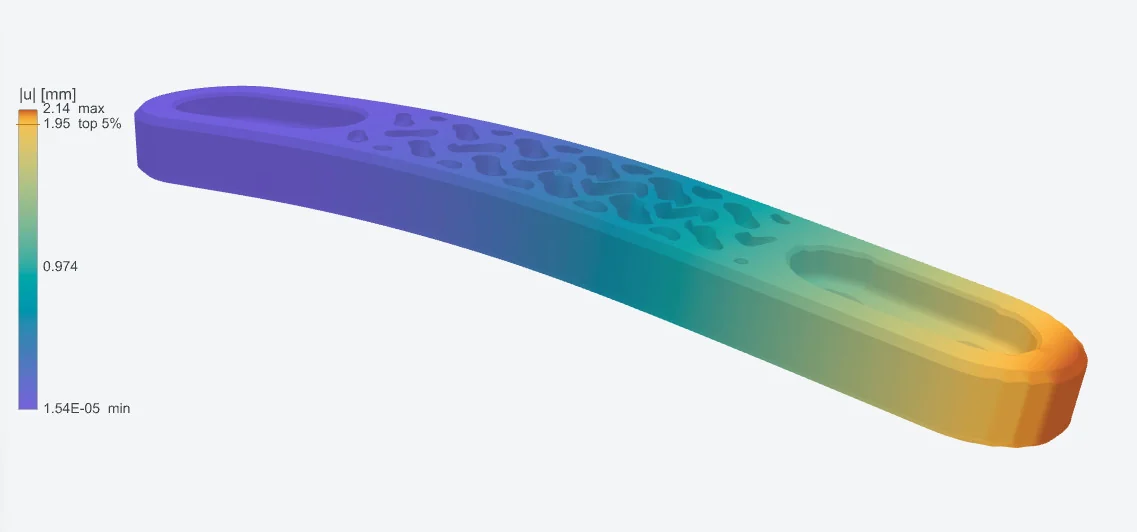
Stress and displacement on implicit solids and lattices: nominal geometry, isotropic materials, solved directly on the field with no meshing step.
Loads, supports, materials
Force, pressure, moment, remote and point loads. Fixed, sliding, symmetry and cylindrical supports. Material presets, including alloys used in additive manufacturing.
GPU solving, free
The production solve path runs on NVIDIA (CUDA) hardware automatically, and falls back to CPU on its own, at the same answers and slower. Not a paid add-on.
A convergence solver
Converge refines geometry and mesh together, extrapolates to the limit, and reports the remaining error, so “was my resolution fine enough” has an answer.
Mesh-free display and section cuts
Results painted straight on the geometry by GPU raymarching, and section planes that color the cut interior. FieldView draws the field itself: streamlines, hedgehogs, tags.
Watertight mesh export
Mesh only at the end, once a solution is found: MurexMesh writes a watertight, sharp-feature mesh for downstream work.
Published verification
Checked against analytic benchmarks and an independent solver, CalculiX 2.22, with the results published raw as well as extrapolated.
Free, unlimited solving
Free to download and use; unlimited solving behind a one-time free account. Works online or offline.
Where it’s going
None of this is built yet.
More physics
Multiple load cases
Define several load cases on one model and read the governing one, instead of re-wiring the canvas per case.
Gravity and body loads
Self-weight, and acceleration loads on the whole body.
Modal analysis
Natural frequencies and mode shapes, on the same meshless foundation.
Thermal analysis
Heat conduction, and the thermal stress it drives.
Nonlinear analysis
Large deflection and material nonlinearity: more of what real parts do under real loads.
Multi-material models
More than one material in a single model.
Automation
Batch and comparison grids
Solve a family of variants, or a set of load cases, and read them side by side. The design loop becomes a design sweep.
Solve to the limit
Push a parameter until the part stops passing, and report where that happened, instead of you bisecting it by hand.
Automatic reports
A written, shareable report out of a finished study.
AI-assisted setup
Describe the study and have it wired for you, including design-of-experiments sweeps, through an assistant connected over MCP.
Implicit export to 3MF
Volumetric export straight from the field, for printers that take it.
Optimization
Field-graded optimization
Topology optimization decides where material goes. Field-graded optimization decides what the material is like, everywhere: density, type and orientation graded to the load, with nothing emptied out.
Solve, grade, regenerate, solve again: a closed loop producing robust, manufacturable parts. The geometry this software is named for.
Topology optimization
The classic result: material kept where it works and removed where it does nothing, computed on an evaluation with no mesh to fail.
Pricing
The solver stays free, and so does the convergence solver: unlimited solving on your own machine, with results, section cuts and commercial work included.
A paid tier will add capability on top: batch automation, optimization, and AI-assisted setup and design-of-experiments through an MCP integration.
It will be a simple monthly subscription, at a fraction of what simulation software usually costs, covering development, support and the integrations that follow.